Geometry Problem 1622
Outer Hexagon Formed by External Squares on a Triangle
Problem Statement
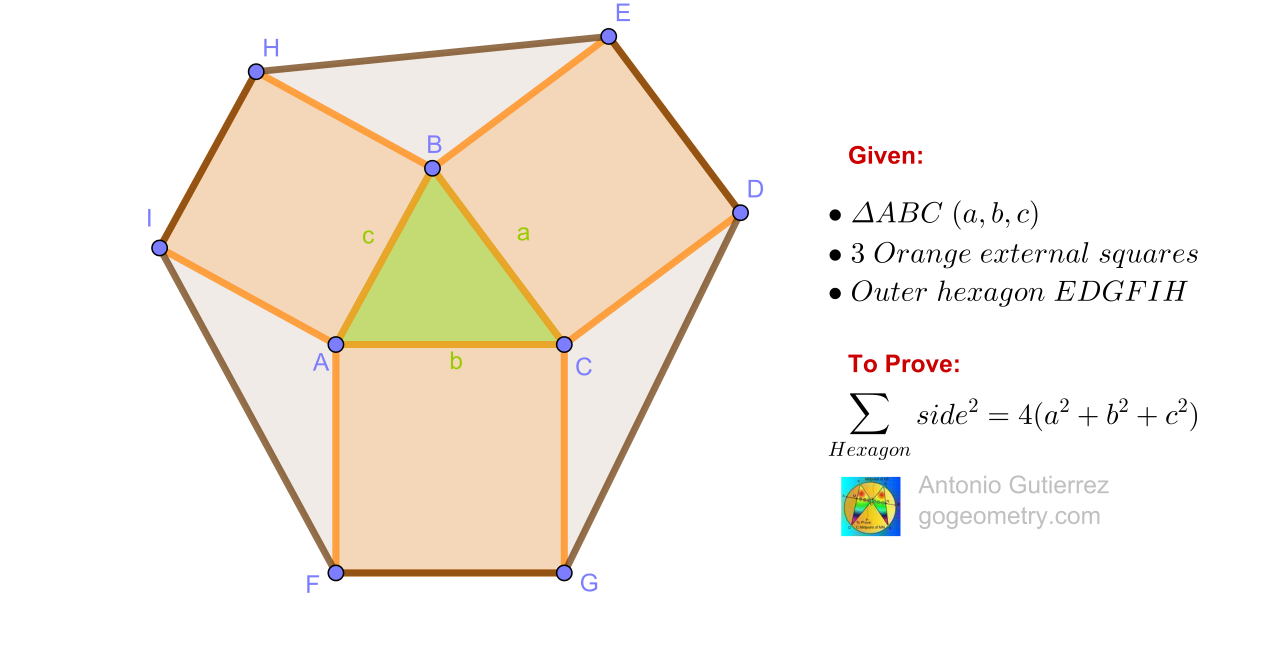
Let $BCDE$, $CAFG$, and $ABHI$ be squares constructed externally on sides $BC$, $CA$, and $AB$ of triangle $ABC$, respectively, forming an outer hexagon $EDGFIH$.
To Prove:
Strategic Synthetic Hints
- Idea 1 — Orthodiagonal Quadrilaterals: Examine quadrilateral $BDGA$ formed by connecting square corners to triangle vertices. What geometric transformation reveals a special relationship between its diagonals, and what metric property applies to such quadrilaterals?
- Idea 2 — Auxiliary Parallelograms: Consider completing a parallelogram on two adjacent sides of triangle $ABC$. Can you discover a congruent triangle that connects the outer connecting segment directly to a diagonal of this parallelogram?
- Idea 3 — Medians & Rotations: Investigate how the outer connecting segment $DG$ relates in direction and length to the median drawn from vertex $C$. Which classical triangle theorem relates medians to side lengths?
- Idea 4 — Structural Symmetry: Distinguish between the three direct square sides and the three connecting gap segments of hexagon $EDGFIH$. How does finding a metric expression for one gap segment solve the entire sum?
Foundation Theorems — Direct Tools
Pattern note: The two-square configuration in Problem 502 illustrates the median relation that, applied cyclically to vertices A, B, C, yields the three gap segments DG, FI, and HE. Apollonius' theorem provides the algebraic backbone for the sum.
Have a creative solution or want to see others?
Compare your solution with those submitted by geometry enthusiasts from around the world, or contribute your own proof.
Explore GoGeometry Database with Google Custom Search
Search the GoGeometry collection of more than 1,600 illustrated geometry problems, organized by diagrams, theorems, constructions, and proof techniques.