From Machu Picchu to MIT: A Geometric Echo of Einstein in Guennette
Published: August 15, 2025 | Last Updated: January 31, 2026
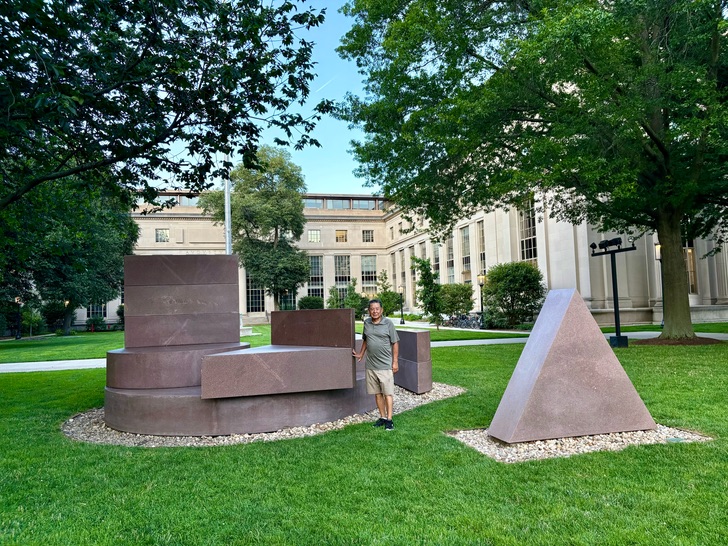
During my recent visit to Boston, I found myself in Killian Court at MIT, face to face with Michael Heizer’s monumental sculpture Guennette. As a professor of geometry from Peru, the sight of its massive granite forms stirred a familiar sensation—one I have often felt walking among the stones of Machu Picchu.
Like the finely fitted blocks of the Inca citadel, Guennette is composed of precisely shaped granite slabs, in this case quarried from Guennette, Quebec. The rock’s geological age—over a billion years—immediately impressed upon me its immense mass (\(m\)), and with it, the hidden energy (\(E\)) contained in matter, as expressed by Einstein’s \(E=mc^2\).
The sculpture’s geometry—a bold disc, segmented circles, and a triangular slab—organizes space with the same quiet authority the Incas achieved in their temples and terraces. In Einstein’s equation, the speed of light (\(c\)) connects space and time; in Guennette, geometry is the language that defines space, much as Inca builders used form to define their sacred sites.
And then there is time. The pink Laurentian granite holds a temporal scale that humbles any human endeavor. In this way, it mirrors the timeless stones of Machu Picchu, which have withstood centuries of sun, rain, and earthquakes. Here at MIT, this ancient material speaks across millennia, anchoring a modern campus in the deep history of our planet.
Standing there, I felt Guennette bridge two worlds: the Andean heights where stone tells the story of a civilization, and this academic court where stone converses with science. In both, mass, space, and time converge—a quiet but powerful reminder that the truths of the universe can be carved into rock as surely as they can be written in equations.
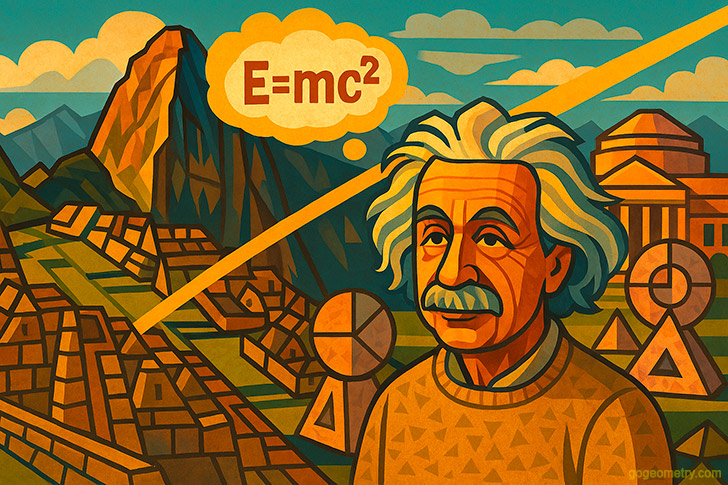
Einstein, Inca Geometry, and Modern Physics: A Visual Dialogue Across Time
This illustration integrates three domains central to the discussion: the geometric legacy of Machu Picchu, the theoretical contributions of Albert Einstein, and the contemporary sculptural articulation of physics at MIT. By situating Einstein between the Inca citadel and the Guennette granite forms, the composition foregrounds the conceptual interplay among mass, energy, light, and geometric structure. It emphasizes the continuity between ancient architectural reasoning and modern scientific inquiry, both of which seek to interpret the universe through principles of form, symmetry, and spatial abstraction.