Geometry Problem 1627
Three Mutually Tangent Circles, Collinear Centers, and Curvilinear Incircle Radii Relations
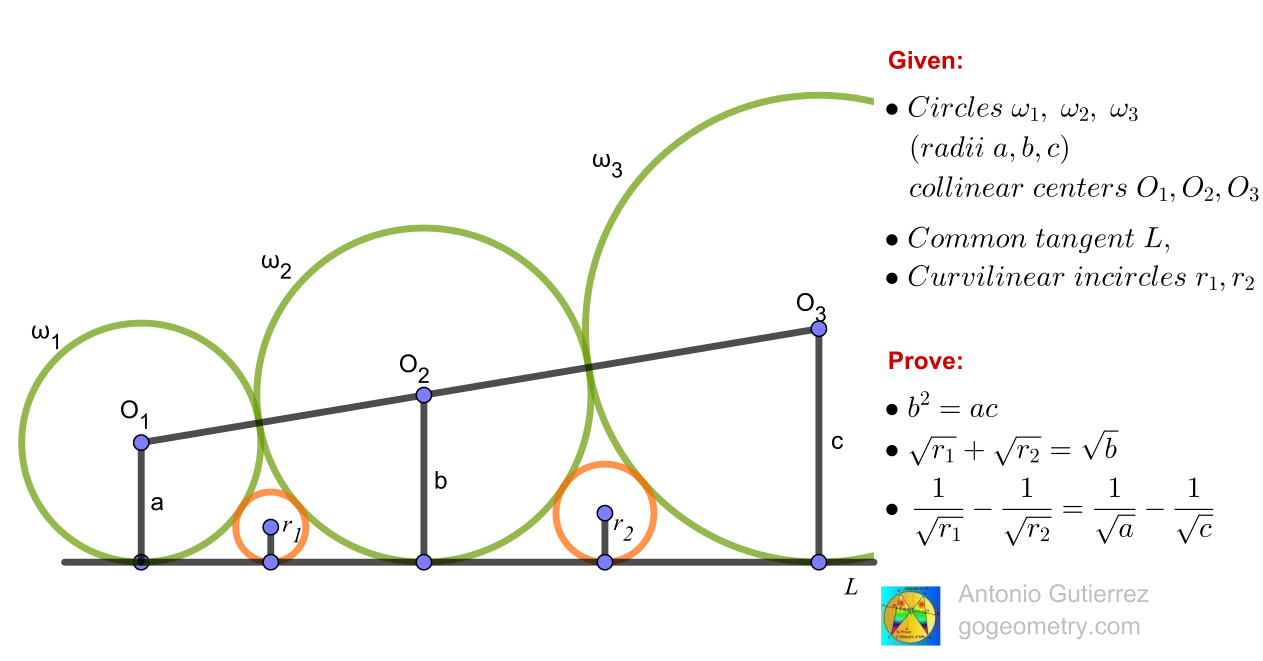
Problem Statement
Let $\omega_1, \omega_2, \omega_3$ be three circles with collinear centers $O_1, O_2, O_3$, in that order, and respective radii $a, b, c > 0$. Suppose that $\omega_1$ and $\omega_2$ are externally tangent, as are $\omega_2$ and $\omega_3$. Let $L$ be a common external tangent to all three circles, with the circles lying on the same side of $L$.
Let $r_1$ be the radius of the circle inscribed in the curvilinear triangle formed by $\omega_1$, $\omega_2$, and $L$. Similarly, let $r_2$ be the radius of the circle inscribed in the curvilinear triangle formed by $\omega_2$, $\omega_3$, and $L$.
Prove that:
Synthetic Hints & Proof Strategy
- Idea 1 — Projections and Similar Triangles: Drop perpendiculars from the centers $O_1, O_2, O_3$ to the common tangent line $L$. Use right-angled projection triangles and similarity from their intersection point $P$ to establish side ratios.
- Idea 2 — Geometric Progression Condition: Deduce from the collinearity of the centers and the projection ratios that $b^2 = ac$, serving as the structural foundation for the configuration.
- Idea 3 — Curvilinear Incircle Formula: Apply the fundamental relation for incircles in curvilinear triangles formed by two tangent circles and a line: $\frac{1}{\sqrt{r_i}} = \frac{1}{\sqrt{x}} + \frac{1}{\sqrt{y}}$.
- Idea 4 — Harmonic Difference: Combine the expressions for $r_1$ and $r_2$ and subtract their inverse square roots to eliminate the middle radius $b$ and arrive at the boundary radius identity.
Foundation Theorems — Direct Tools
Pattern note: The collinear centers of mutually tangent circles naturally lock into a powerful geometric mean proportion, bridging radical axes with harmonic radical lengths.
Have a creative solution or want to see others?
Compare your solution with those submitted by geometry enthusiasts from around the world, or contribute your own proof.
Explore GoGeometry Database with Google Custom Search
Search the GoGeometry collection of more than 1,600 illustrated geometry problems, organized by diagrams, theorems, constructions, and proof techniques.