Geometry Problem 1619
Right Triangle Area, Inradius, and Hypotenuse Relation
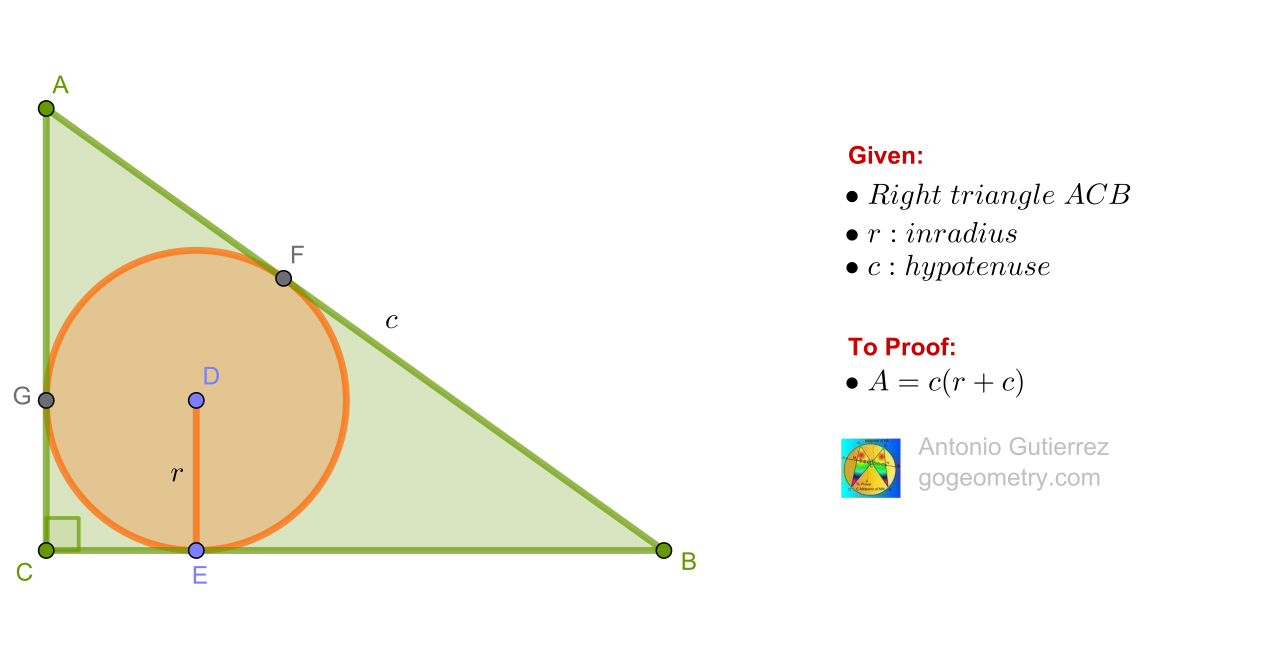
Problem Statement
In any right triangle, the area is equal to the inradius multiplied by the sum of the inradius and the hypotenuse.
To Prove:
$$\text{Area} = r(r + c)$$
where $r$ is the inradius and $c$ is the length of the hypotenuse.
Explore GoGeometry Database with Google Custom Search
Search for related invariants, auxiliary lines, or proofs across our 1,600+ academic geometry problems.
Strategic Hints
- Area Decomposition: Consider joining the incenter $O$ to all three vertices. How does the area of the triangle over the hypotenuse compare to the combined area over the two catheti?
- Tangency Property: Recall that for a right triangle with catheti $a, b$ and hypotenuse $c$, the sum of the catheti satisfies $a + b = c + 2r$.
- The Corner Square: Notice that the inradius and the two legs at the right angle form a square of area $r^2$.
- Direct Sum Formulation: Write the total area as $\text{Area} = 2\left(\frac{c \cdot r}{2}\right) + r^2$. How does factoring out $r$ lead directly to the desired formula?
Have a creative solution or want to see others?
View or Post Solutions on Blogger