|
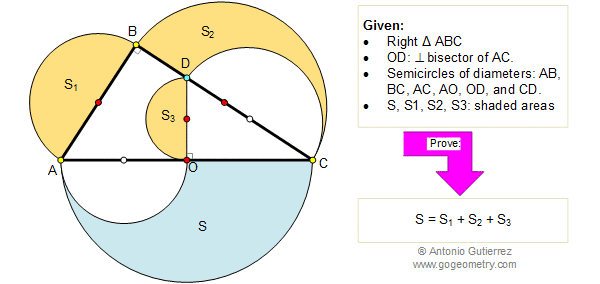
In the figure below, given a
right triangle ABC and semicircles of diameters AB, BC, AC, AO,
OD, and CD respectively. If OD is the perpendicular bisector of
AC and S, S1, S2, and S3 are the shaded areas, prove that: S = S1 + S2 + S3
Post
a comment
|
FACTS AND HINTS:
Geometry problem solving is one of the most challenging skills for students to learn. When a
problem requires auxiliary construction, the difficulty of the problem increases drastically, perhaps because deciding which construction to make is an ill-structured problem. By “construction,” we mean adding geometric figures (points, lines, planes) to a problem figure that wasn’t mentioned as "given."
1. See: :
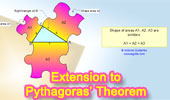
The General Extension to Pythagoras' Theorem.

|