|
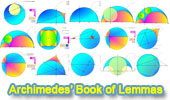 |
Archimedes' Book of Lemmas-
Table of Content
Archimedes wrote
the "Book of Lemmas" more than 2200 years ago. Solve these 15
high school level problems and lift up your geometry skills.
|
|
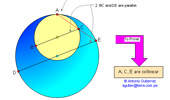 |
Proposition 1.
Tangent circles and parallel diameters |
|
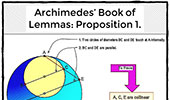 |
Etching and Typography of Geometry Problem 640.
Archimedes Book of Lemmas: Proposition 1
Using iPad Apps. |
|
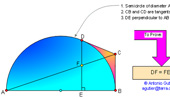 |
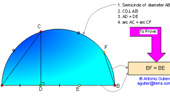
Proposition 2
Semicircle, diameter, tangents, secant line. |
|
 |
Proposition 3
Semicircle, perpendicular to diameter, chords. |
|
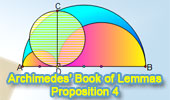 |
Proposition 4
Semicircles, perpendicular to diameter, Arbelos.
|
|
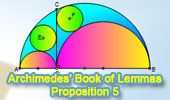 |
Proposition 5
Arbelos, Archimedean Twins,
Semicircles, Circles
|
|
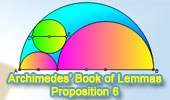 |
Proposition 6
Arbelos, Semicircles, Circle.
|
|
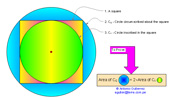 |
Proposition 7
Square and inscribed and circumscribed Circles
|
|
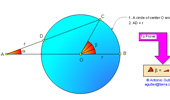 |
Proposition 8
Angle Trisection. Neusis construction. |
|
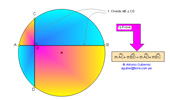 |
Proposition 9.
Perpendicular chords, sum of arcs. |
|
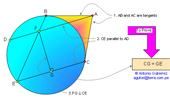 |
Proposition 10
Tangents to a circle, secant line and chords, Parallel. |
|
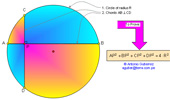 |
Proposition 11
Perpendicular chords� and radius, square. |
|
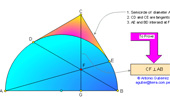 |
Proposition 12
Semicircle, Diameter, Chords, Tangents, Perpendicular. |
|
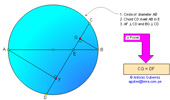 |
Proposition 13
Circle, Diameter, Chord, Perpendicular, Congruence. |
|
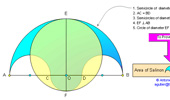 |
Proposition 14
Salinon: Semicircles, Perpendicular, Circles, Areas. |
|
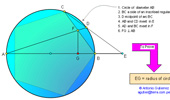 |
Proposition 15
Circle, Diameter, Inscribed Regular Pentagon, Arc, Midpoint,
Perpendicular, Radius. |
|
|
Arbelos, Theorems and Problems
Three tangent semicircles with collinear
centers.
Index |
|
|
Geometric Art: Typography of Archimedes' Book of Lemmas |



