Successive Golden Rectangles dividing a Golden
Rectangle into squares (logarithmic spiral known as the golden spiral)
The Statue of Liberty
The Statue of Liberty was presented to
the United States by the people of
France in 1886. Standing on Liberty
Island in New York Harbor, it welcomes
visitors, immigrants, and returning
Americans.
Golden rectangle
A golden rectangle
is a rectangle whose side lengths are in the golden ratio,
one-to-phi, that is, approximately 1:1.618. A distinctive
feature of this shape is that when a square section is
removed, the remainder is another golden rectangle, that is,
with the same proportions as the first. Square removal can
be repeated infinitely, which leads to an approximation of
the golden or Fibonacci spiral.
Droste Effect
The Droste effect is a specific kind of recursive picture, one that in heraldry is termed mise en abyme. An image exhibiting the Droste effect depicts a smaller version of itself in a place where a similar picture would realistically be expected to appear. This smaller version then depicts an even smaller version of itself in the same place, and so on. Only in theory could this go on forever; practically, it continues only as long as the resolution of the picture allows, which is relatively short, since each iteration geometrically reduces the picture's size. It is a visual example of a strange loop, a self-referential system of instancing which is the cornerstone of fractal geometry.
Source:
Wikipedia,
Droste Effect.
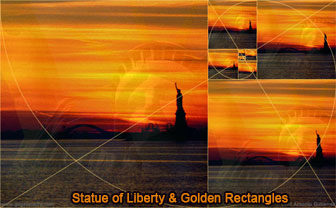
 The Golden Rectangle and the Statue of Liberty, New York City