Home Software Word Clouds Post a comment

Cloud computing is an example of computing in which dynamically scalable and often virtualized resources are provided as a service over the Internet. Users need not have knowledge of, expertise in, or control over the technology infrastructure in the "cloud" that supports them.

A technical definition is that "cloud computing is a model for enabling convenient, on-demand network access to a shared pool of configurable computing resources (e.g., networks, servers, storage, applications, and services) that can be rapidly provisioned and released with minimal management effort or service provider interaction." This definition states that clouds have five essential characteristics: on-demand self-service, broad network access, resource pooling, rapid elasticity, and measured service. Source: Wikipedia Cloud Computing.

Word Cloud

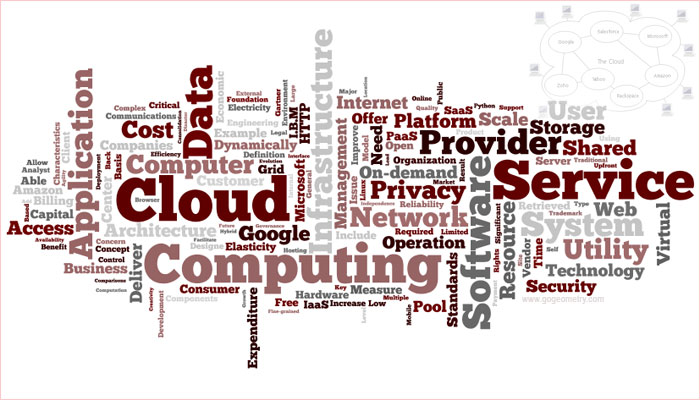
Word cloud or tag cloud (or weighted list in visual design) is a visual depiction of user-generated tags, or simply the word content of a site, used typically to describe the content of web sites. Tags are usually single words and are typically listed alphabetically, and the importance of a tag is shown with font size or color. Thus both finding a tag by alphabet and by popularity is possible. The tags are usually hyperlinks that lead to a collection of items that are associated with a tag.

The word cloud image was generated by Wordle.net.
 

Online Book Shopping


Cloud Computing, A Practical Approach
by Toby Velte, Robert Elsenpeter, Anthony Velte
(Paperback)

Cloud Computing: A Practical Approach provides a comprehensive look at the emerging paradigm of Internet-based enterprise applications and services. This accessible book offers a broad introduction to cloud computing, reviews a wide variety of currently available solutions, and discusses the cost savings and organizational and operational benefits. You'll find details on essential topics, such as hardware, platforms, standards, migration, security, and storage. You'll also learn what other organizations are doing and where they're headed with cloud computing. If your company is considering the move from a traditional network infrastructure to a cutting-edge cloud solution, you need this strategic guide.

Cloud Computing: A Practical Approach covers:

  • Costs, benefits, security issues, regulatory concerns, and limitations
  • Service providers, including Google, Microsoft, Amazon, Yahoo, IBM, EMC/VMware, Salesforce.com, and others
  • Hardware, infrastructure, clients, platforms, applications, services, and storage
  • Standards, including HTTP, HTML, DHTML, XMPP, SSL, and OpenID
  • Web services, such as REST, SOAP, and JSON
  • Platform as a Service (PaaS), Software as a Service (SaaS), and Software plus Services (S+S)
  • Custom application development environments, frameworks, strategies, and solutions
  • Local clouds, thin clients, and virtualization
  • Migration, best practices, and emerging standards
  Recent Additions
The image left shows the most popular words on Cloud Computing, with the most frequently used words given greater prominence (larger font).