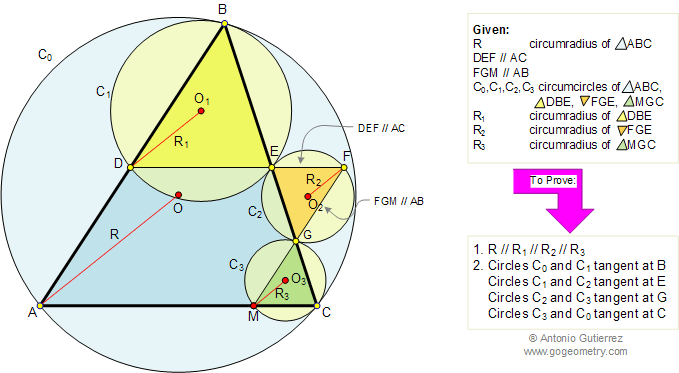
Problem 92. Similar Triangles, Circumcircles, Circumradii, Parallel. Level: High School, SAT Prep, College

In the figure below, given a triangle ABC, circumcircle C0, circumradius R, line DEF parallel to AC and line FGM parallel to AB. C1, C2, and C3, and R1, R2, and R3 are the circumcircles and circumradii of triangles DBE, FGE, and MGC respectively, prove that: R // R1 // R2 // R3, and circles C0 and C1 are tangent at B, circles C1 and C2 are tangent at E, circles C2 and C3 are tangent at G, and circles C3 and C0 are tangent at C. Post a comment.

Similar triangles, parallel, tangent circles. Elearning 


FACTS AND HINTS:

Geometry problem solving is one of the most challenging skills for students to learn. When a problem requires auxiliary construction, the difficulty of the problem increases drastically, perhaps because deciding which construction to make is an ill-structured problem. By “construction,” we mean adding geometric figures (points, lines, planes) to a problem figure that wasn’t mentioned as "given."


1. SIMILAR TRIANGLES:
Proposition:
Corresponding angles of similar triangles are congruent.


2. PROVING THAT LINES ARE PARALLEL:
Proposition:
Two lines are parallel if a pair of corresponding angles are congruent.
Proposition: Two lines are parallel if a pair of alternate interior angles are congruent.


3. CIRCLES TANGENT:
Proposition:
In the figure above, circles C0 and C1 are tangent internally if the line of center OO1 extended passes through B.
Proposition: In the figure above, circles C1 and C2 are tangent externally if the line of center O1O2 passes through G.


Similarity problem, elearning 


Home | Search | Problems | All Problems | Email

Last updated: May 22, 2009