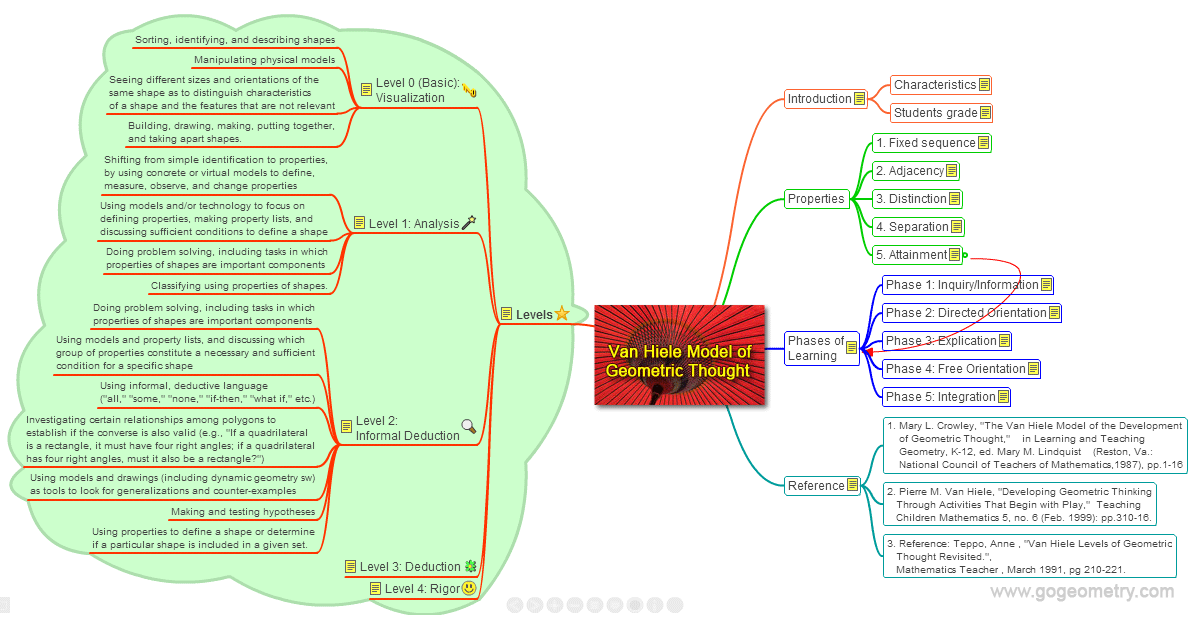
Mind Map Description
The interactive Mind Map for the van Hiele Model
of Geometric Thought is an image-centered diagram that represents
connections between various topics and concepts related to van Hiele theory.
Van Hiele Model of Geometric Thought
In math education, the van Hiele model is a theory that describes how students learn geometry. The theory originated in 1957 in the doctoral dissertations of Dina van Hiele-Geldof and Pierre van Hiele (wife and husband) at Utrecht University, in the Netherlands. The Soviets did research on the theory in the 1960s and integrated their findings into their curricula. American researchers did several large studies on the van Hiele theory in the late 1970s and early 1980s and Pierre van Hiele published Structure and Insight in 1986, further describing his theory. The model has greatly influenced geometry curricula throughout the world. In the United States, the theory has influenced the geometry strand of the Standards published by the National Council of Teachers of Mathematics and the new proposed Common Core Standards.
Source:
Wikipedia, Van Hiele Model.
Van Hiele levels are a product of
experience rather than age. In other words, a child must have enough experiences
(classroom or otherwise) with these geometric ideas to move to a higher level of
sophistication.
Using the van Hiele model as a basis, the users will know how students
understand geometric concepts and how to determine the reasoning levels of these
students.
-
Level 0. (Basic Level)
Visualization:
children identify prototypes of basic geometrical figures
(triangle, circle, square). At this age (or stage), children
might balk at calling a thin, wedge-shaped triangle (with sides
1, 20, 20 or sides 20, 20, 39) a "triangle", because it's so
different in shape from an equilateral triangle.
-
Level 1. Analysis: children
can discuss the properties of the basic figures and recognize
them by these properties, but might still insist that "a square
is not a rectangle."
-
Level 2. Abstraction:
learners recognize relationships between types of shapes. They
recognize that all squares are rectangles, but not all
rectangles are squares. They can tell whether it is possible or
not to have a rectangle that is, for example, also a rhombus.
Students need to be comfortably at this level to be well
prepared for a high school geometry course (though many students
are not). One of our goals in this class will be to consider
ways that we can help children progress to a level 2
understanding of some important geometric topics.
-
Level 3. Deduction: learners
can construct geometric proofs at a high school level. Learners
should be exposed to deduction at a pre-high-school level in the
context of level 2 discussions (what properties tell us that all
squares are also rectangles), but the primary consideration of
level 3 work will not be discussed in this course.
-
Level 4. Rigor: learners
understand how geometry proofs and concepts fit together to
create the structure we call geometry. This is the level at
which most college geometry courses (for math majors) are
designed.
Last updated: October 11, 2010