|
|
|
Geometry in the Widsom of Abraham Lincoln, 1809-65. 16th U.S. President
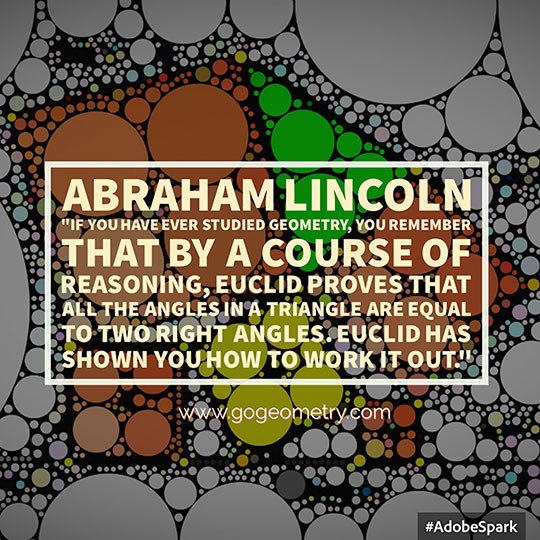
"If you have ever studied geometry, you remember that by a course of reasoning, Euclid proves that all the angles in a triangle are equal to two right angles. Euclid has shown you how to work it out. Now, if you undertake to disprove that proposition, and to show that it is erroneous, would you prove it to be false by calling Euclid a liar?"
Political Debates Between Lincoln and Judge Douglas. Fourth Joint Debate at Charleston, 1858.
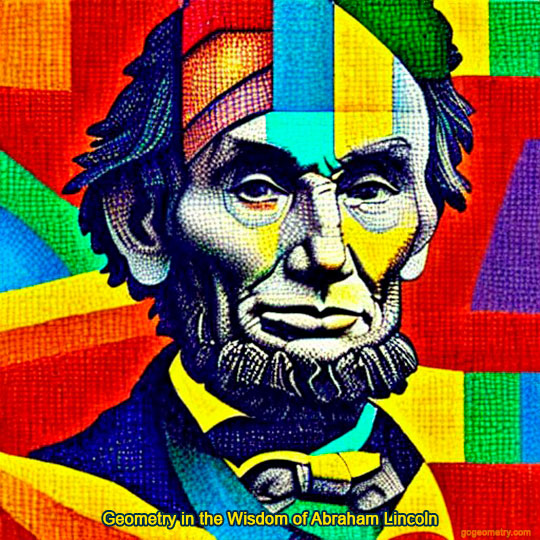
Lincoln's mind aglow,
Geometry's truths unfold,
Wisdom's dance bestowed.

"He studied and nearly mastered the Six-books of Euclid (geometry) since he was a member of Congress. He began a course of rigid mental discipline with the intent to improve his faculties, especially his powers of logic and language. Hence his fondness for Euclid, which he carried with him on the circuit till he could demonstrate with ease all the propositions in the six books; often studying far into the night, with a candle near his pillow, while his fellow-lawyers, half a dozen in a room, filled the air with interminable snoring."
Abraham Lincoln from Short Autobiography of 1860.
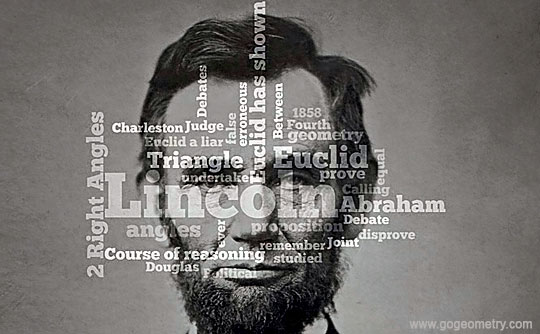
"There are two ways of establishing a proposition. One is by trying to demonstrate it upon reason, and the other is, to show that great men in former times have thought so and so, and thus to pass it by the weight of pure authority. Now, if Judge Douglas will demonstrate somehow that this is popular sovereignty,—the right of one man to make a slave of another, without any right in that other, or anyone else to object,—demonstrate it as Euclid demonstrated propositions,—there is no objection. But when he comes forward, seeking to carry a principle by bringing it to the authority of men who themselves utterly repudiate that principle, I ask that he shall not be permitted to do it."
Speech of Hon. Abraham Lincoln. At Columbus, Ohio, September, 1859.
|
|
