|
Albert Einstein About Pythagoras Theorem Proof
'At the age of 12 I experienced a second wonder of a
totally different nature: in a little book dealing with Euclidean plane
geometry, which came into my hands at the beginning of a school year.
Here were assertions, as for example the intersection of the three
altitudes of a triangle in one point, which - though by no means evident
- could nevertheless be proved with such certainty that any doubt
appeared to be out of the question. This lucidity and certainty made an
indescribable impression upon me. For example I remember that an uncle
told me the Pythagorean theorem before the holy geometry booklet had
come into my hands. After much effort I succeeded in ``proving'' this
theorem on the basis of the similarity of triangles ... for anyone who
experiences [these feelings] for the first time, it is marvellous enough
that man is capable at all to reach such a degree of certainty and
purity in pure thinking as the Greeks showed us for the first time to be
possible in geometry.'
Albert Einstein: Philosopher-Scientist, by Paul Arthur Schilpp, 1951.
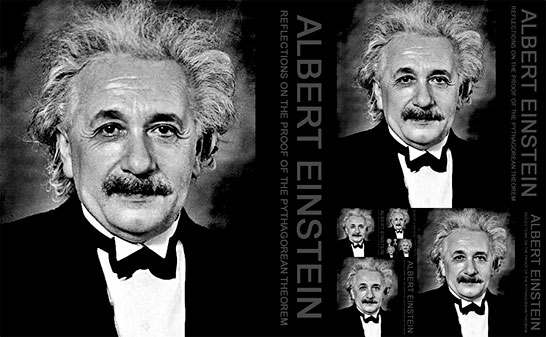 
Einstein, Albert. 1879-1955. German-born American
physicist and Nobel laureate.
"A human being is part of a whole, called by us the Universe, a part
limited in time and space. He experiences himself, his thoughts and
feelings, as something separated from the rest a kind of optical
delusion of his consciousness. This delusion is a kind of prison for us,
restricting us to our personal desires and to affection for a few
persons nearest us. Our task must be to free ourselves from this prison
by widening our circles of compassion to embrace all living creatures
and the whole of nature in its beauty.
The pursuit of truth and beauty is a sphere of activity in which we are
permitted to remain children all our lives.
To raise new questions, new possibilities, to regard old problems from a
new angle, requires creative imagination and marks real advance in
science."
"Imagination is more important than knowledge."
On Science.
"Do not worry about your difficulties in mathematics, I assure
you that mine are greater."
"The search for truth is more precious than its possession."
The American Mathematical Monthly v. 100 no. 3.
"We come now to the question: what is a priori
certain or necessary, respectively in geometry (doctrine of space) or
its foundations? Formerly we thought everything; nowadays we think
nothing. Already the distance-concept is logically arbitrary; there need
be no things that correspond to it, even approximately."
"Space-Time." Encyclopaedia Britannica, 14th ed.
|
