|

|
Home |
Equilic Quadrilateral |
Previous,
1,
2,
3,
4, 5
Geometry Problem 1371: Equilic Quadrilateral, 120
Degrees, Congruence, Midpoint, Diagonal, Equilateral Triangle, Parallel,
Collinearity
|
|
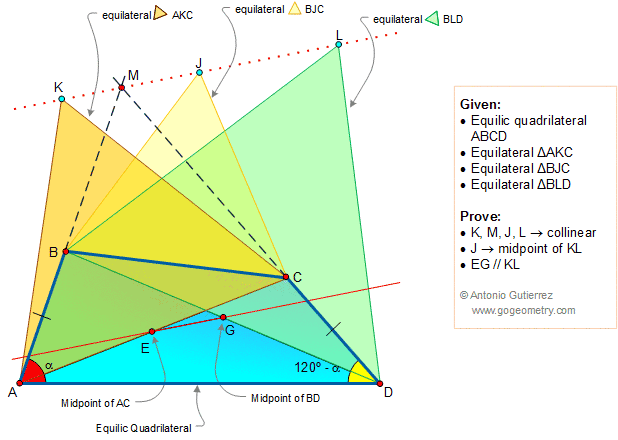
In the figure below ABCD is an
equilic quadrilateral.
If AB meet DC in M, equilateral triangles AKC, BJC and BLD are drawn
away from AD, and E and G are the midpoint of the diagonals AC
and BD, prove that K, M, J and L are collinear, J
is the midpoint of KL and EG and KL are parallel lines.
|
|
|
|
Home |
Search | Geometry
| Problems
| Equilic Quadrilateral
|
All Problems
|
Open Problems
|
Visual
Index
|
Problems 1371-1380 |
Email
| by Antonio Gutierrez
View or Post a solution
|
|